
Jump to section…

Most executive teams have crossed the initial phase of corporate AI adoption. You purchased enterprise software licenses, organized team prompt workshops, and equipped desks with automated drafting assistants.
Yet, when you look closely at daily business operations, work is not moving faster. Instead, your managers spend hours line-editing generic drafts, key milestones slip, and your best employees feel exhausted. Having software access is easy, but achieving AI maturity is a completely different challenge. If you want sustainable business results, you must look beyond raw drafting speed and repair the human workflows underneath.
The Efficiency Trap: Why Faster Output Clogs Your Pipeline
Generative AI lets your employees produce text, slide decks, and data summaries in seconds. However, producing content faster does not mean your organization delivers value faster. When individual team members generate ten times more output without changing how your company reviews work, you trigger an operational logjam.
Research from Harvard Business School shows that while AI acts as a great equalizer during early brainstorming, it hits a steep wall during execution. Non-experts can easily generate polished, professional-sounding documents. Unfortunately, they often lack the deep domain experience required to spot subtle errors, missing context, or flawed logic.
As a result, unvetted work flows straight downstream. Senior managers, directors, and CEOs suddenly become full-time proofreaders and editors. This dynamic creates three major operational headaches:
- Decision fatigue: Leaders drain their mental energy untangling automated text rather than driving business strategy.
- Diluted brand voice: Generic algorithms strip away your unique market perspective, making your pitches look like everyone else’s.
- Team burnout: Instead of enjoying freed-up time, employees face endless revision cycles and heavier workloads.
To escape this trap, growing companies must move from baseline software access toward true AI maturity.
What Separates Basic AI Access from True AI Maturity?
Organizations often confuse tool access with organizational capability. Simply handing employees software logins leads to random experiments, inconsistent quality, and rising frustration. In contrast, institutional AI maturity aligns technology with clear governance and human judgment.
Here is how the two approaches compare:
- Strategic focus: AI access focuses on drafting speed and volume. AI maturity focuses on higher win rates, stronger client relationships, and protected profit margins.
- Workflow design: AI access encourages isolated desktop shortcuts. AI maturity builds clear review gates and established team standards.
- Role of your people: AI access turns specialists into reactive fact-checkers. AI maturity empowers teams as strategic thinkers who use high emotional intelligence.
- Workplace culture: AI access breeds tech fatigue and quiet anxiety. AI maturity builds psychological safety, open feedback, and shared trust.
When your organization embraces AI maturity, you stop asking how quickly you can draft a deliverable. Instead, you ask whether that deliverable sharpens your competitive edge.
The 4 Pillars of Measurable Business Value
Tracking real return on investment means looking past vanity metrics like “hours saved drafting.” To build genuine AI maturity, leaders evaluate success across four operational pillars:
Human Capital Health: If AI adoption increases stress and voluntary turnover, the deployment is failing. Sustainable ROI protects your talent, freeing people to solve complex, rewarding problems.
Pipeline Selectivity: When writing is effortless, teams often chase bad-fit opportunities. Mature teams use data to qualify leads early, focusing energy only on high-margin pursuits.
Differentiated Value: Anyone can generate standard copy. True value happens when automated tools handle routine formatting, leaving your team with the mental energy to craft persuasive, client-centered narratives.
Quality Governance: A single inaccurate figure can destroy client trust. Mature teams establish clear peer-review rubrics so senior leaders do not bear the entire burden of verification.
The Human Fix: How Leadership Coaching Unblocks Workflows
Why do so many digital rollouts stall? The answer is rarely the software. The real barrier is human behavior. When companies introduce automation without coaching their leaders, managers struggle to adapt.
This is where leadership coaching services become your most valuable investment. At a)plan coaching, we know you cannot expand technical capability without expanding human capacity. Through our hybrid model, we combine tailored one-on-one sessions with systemic team coaching:
- One-on-One Executive Coaching: Private sessions help founders and managers build executive presence, sharpen delegation skills, and beat burnout. Leaders learn to establish clear review boundaries rather than rewriting team output.
- Systemic Team Coaching: Group sessions break down communication silos between sales, delivery, and operations. Teams build the psychological safety needed to flag flawed automated drafts and refine handoffs.
- Multiple Action Plans (MAPs): Rather than mandating rigid top-down rules, our proprietary MAPs framework turns digital change into adaptable, scenario-tested goals.
The economic return is clear. Data verified by the International Coaching Federation shows that structured coaching yields an average financial return of seven times the initial investment. Over 70% of participants report direct gains in productivity, communication, and decision speed.
Practicing What We Preach with the a)plan App and a)planAI
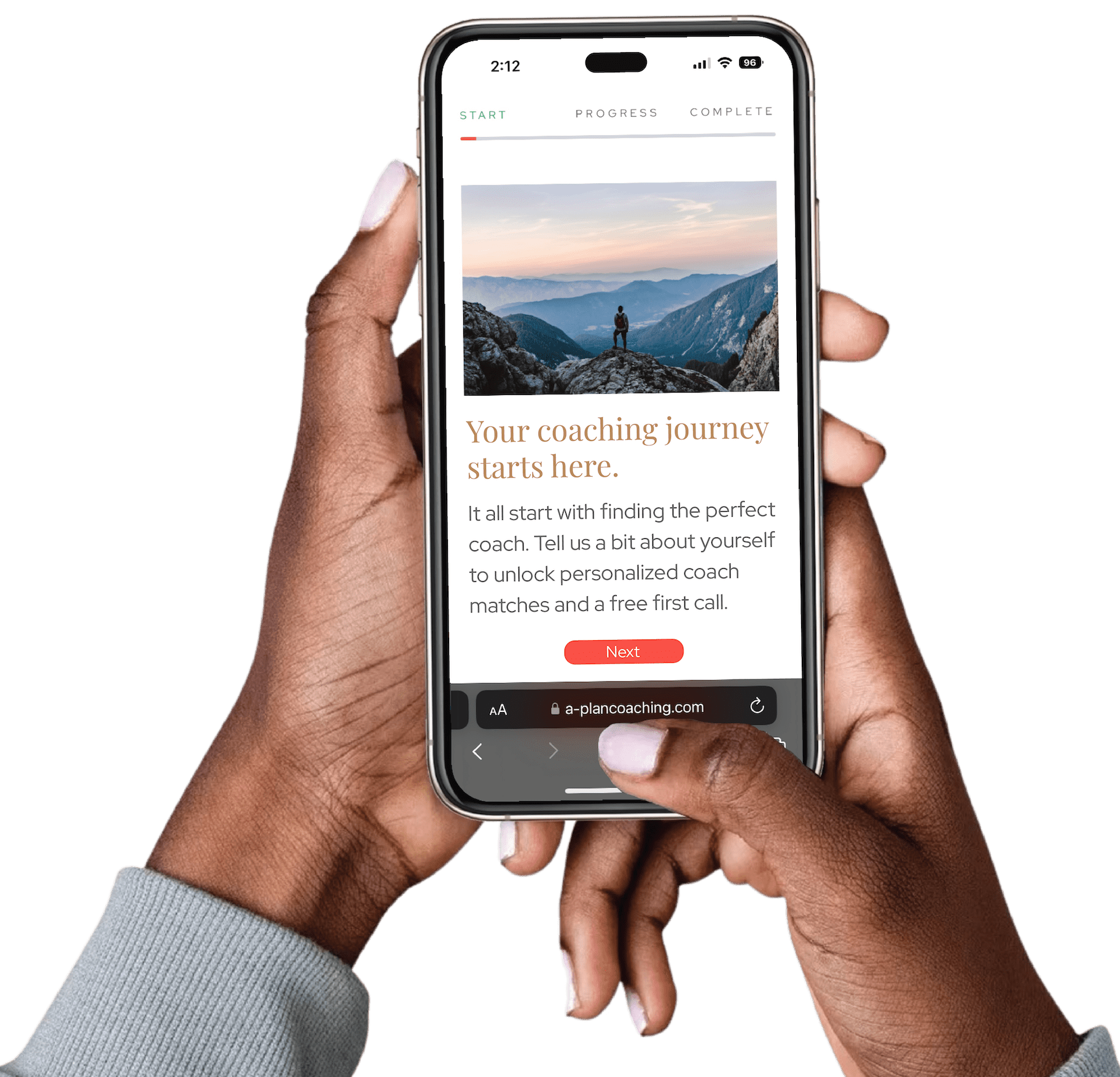
We believe coaching organizations should practice what they preach. That is why we built the a)plan app, complete with our dedicated a)planAI feature.
Most corporate training programs fail because people forget insights between weekly meetings. The a)plan mobile platform bridges that gap by turning big goals into daily micro-habits, gratitude prompts, and actionable reflections.
Unlike tools that attempt to replace human coaches, our built-in a)planAI feature acts as a supportive companion. It provides on-demand reflection prompts grounded in our proven coaching method. Between regular sessions, clients chat with a)planAI to unpack challenges, log micro-wins, and prepare for upcoming meetings.
Your coach views these updates in real time, so every session dives straight into high-impact strategy. By pairing intelligent software with dedicated human support, we showcase what true AI maturity looks like in daily practice.
Is Your Team Ready for AI Maturity?
Before buying another enterprise software license, ask yourself five honest questions:
- Can your team leads explain how AI improves your client value proposition, or do they only track drafting speed?
- Do employees feel safe flagging flawed automated drafts, or do they push content forward to meet arbitrary deadlines?
- Have you mapped out explicit review workflows, or is adoption ad-hoc and chaotic?
- Are you investing as much in developing your managers’ emotional intelligence and delegation skills as you spend on tech tools?
- Do you have structured coaching loops in place to reinforce productive habits over time?
Technology can generate paragraphs in seconds, but it cannot earn client trust, navigate complex negotiations, or rally an exhausted team. When you guide your organization toward true AI maturity, you protect your people, unblock your review pipeline, and build a resilient business that scales.
Ready to transform how your team works?
Book a Discovery Call with a)plan coaching to discover how our tailored coaching programs can support your organization.